
Why we built Samsar

Commentary by Guillermo Garcia, Founding CEO of Samsar
What do we mean when we say a battery is “dead”?
If we’re talking about a AAA alkaline battery, like you’d have in your TV remote, then a “dead” battery has been totally spent and should go to recycling. If we’re talking about a lead-acid battery, like you’d find under the hood of a gas-powered car, then it’s roughly the same.
But the battery powering electric vehicles is different. Dead lithium-ion batteries, or, to use industry jargon, “end-of-life” batteries, still have 80% of their capacity remaining!
When you consider that an EV battery is about half of the car’s value, sending 80% of the battery’s capacity to the recycler starts to look like a huge missed opportunity. Expand that to all the different applications that use lithium batteries and the opportunity become even bigger.
Samsar Resources was founded to capture that value.
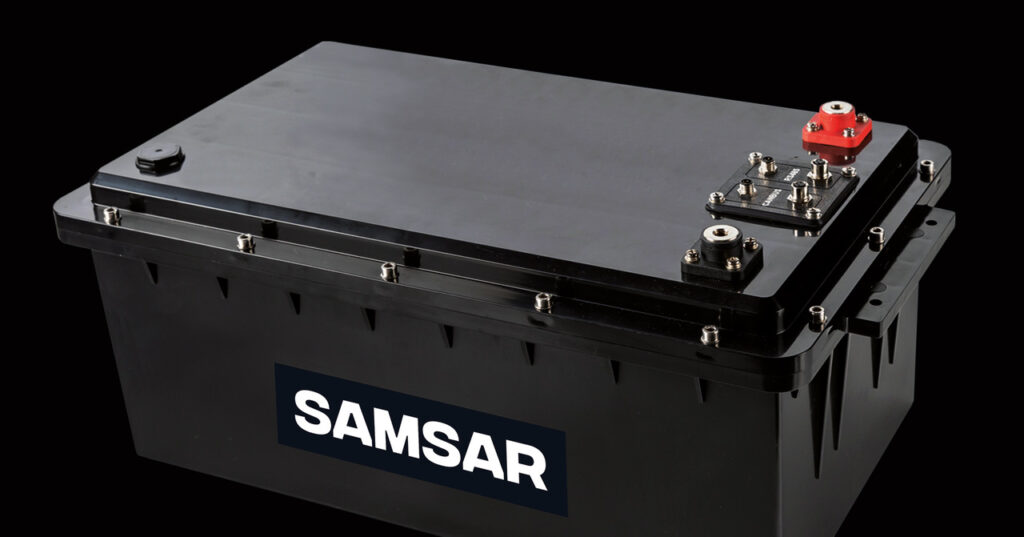
Diverting the tsunami
The coming “tsunami” of end-of-life EV batteries, and lithium batteries in general, is an unsolved problem.
Automotive companies have never had a waste stream like EV batteries before. The sheer concentration of value, the complexity of the product, and the diversity of internal materials is simply unprecedented. Not to mention — these things are heavy! A Nissan Leaf battery weighs over 600 pounds!
We can take some inspiration from the history of the lead-acid battery. Decades ago, most lead-acid batteries simply went to the landfill. But increasing public concern about toxic chemicals prompted the creation of the lead-acid recycling system, which is now the most comprehensive circular economy in the world. Today, we collectively recycle 99% of lead-acid batteries. Product design, warranties, and logistical best practices all play a role in this unparalleled success story.
As the first generation of electric vehicles finally begins to leave the field, we are seeing the first trickles in what will eventually become a tidal wave of used batteries. The same is happening with utility scale energy storage, and all the other applications where lithium batteries are used. The time to step up is now.
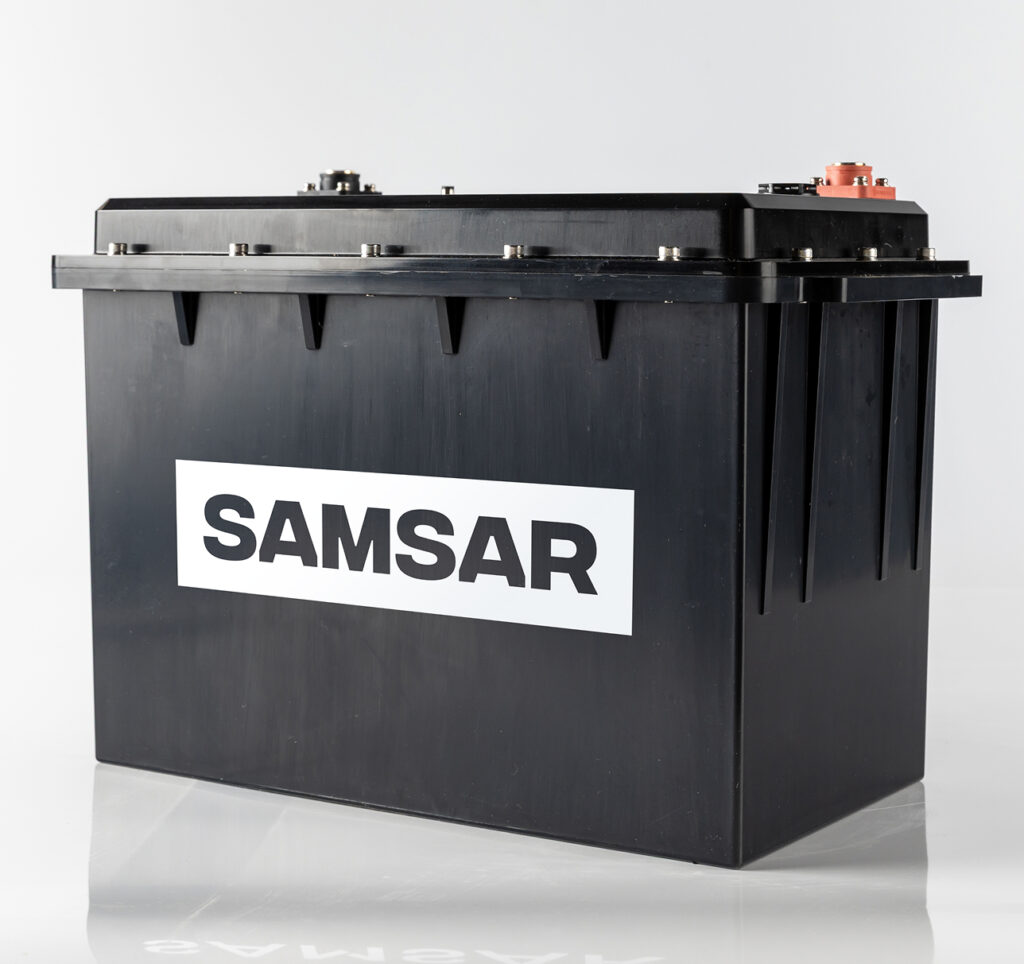
Scaling big by going small
Many startups are purchasing used EV batteries in order to assemble them into stationary storage solutions. That’s a great business if you can handle the capex (and the warranty risk) but we founded Samsar to be lean and efficient from the beginning. We decided to remanufacture in the other direction — smaller.
Samsar remanufactures used EV batteries into second-life applications where modern lithium-ion can replace legacy lead-acid batteries.
As a practical matter, this approach has several advantages:
1. Every cell in a Samsar battery has a very similar state of health to its peers, because they were sourced from the same module in the same car.
2. Samsar can develop products that are directly re-purposing modules (after accounting for quality control).
3. Our team can design for markets that are too segmented for overseas gigafactories to focus on, avoiding direct competition from new batteries.
4. Launching new products costs less.
We designed our business around “going small” from day one. We believe that repurposing EV batteries into small-wattage applications is our best path to repurposing at scale.
Our vision: unlocking the full potential of lithium batteries
Today, Samsar does a healthy business remanufacturing lithium batteries from many different applications, including electric vehicles. But our long-term vision is much more expansive. We’re setting up a circular business model that unlocks maximal value from lithium-ion batteries.
Our team’s experience remanufacturing batteries into new packs has taught us a lot about what makes a battery easy to re-use. We do this every day! Here are a couple of important lessons we’ve learned that were not obvious when we founded the company:
- Utilize modular architecture for battery components
- Implement designs for disassembly that remove adhesives and focus on fasteners and brackets
- Incorporate serviceability to enable easy access to key components (electronics, cells/modules, wiring, and connectors)
- Integrate cell monitoring and material traceability via battery passports
Now that we’re holding this hard-earned expertise, Samsar has launched several new products. We now sell brand new battery packs that are designed for quick remanufacturing, and thereby become our own supplier. We also have launched a battery-as-a-service (BaaS) program, structured as a leasing program, that guarantees battery uptime for our customers across a diverse set of verticals. And we developed our industry-leading NthLife™ Battery Passport that gives our customers detailed quality control data like how the battery was tested and certified, as well as product histories (like we’re accustomed to seeing for used cars) and anticipates a growing global body of sustainability regulations.
What all these offers have in common is that they capture value from the full lifetime of a lithium-ion battery. Samsar’s core insight — that sending 80% of a battery’s capacity to the recycler is a missed opportunity — is taking the company in exciting new directions.
Our story so far
In many ways, this blog post comes a few years late. I was thrilled to join Samsar as Founding CEO in 2022. We kept our footprint light to make sure that our “go small” thesis was supported by evidence and focused on speaking with customers. We hired our tremendous leadership team to fulfill customer demand (and not the other way around).
But, ultimately, the insights at the core of our business haven’t changed these past four years. The US still doesn’t have a systemic strategy the incoming tsunami of used EV batteries. Or all of the other lithium batteries that increasingly power our lives. And sending 80% of a battery into recycling is still a terrible waste.
Today, Samsar is doing deals and growing fast.
- We have repurposed over 35MWh of batteries to date across North America, Europe, and Asia with new product lines launching in Q3 2026 (look for that announcement, coming soon).
- We are a critical vendor for the security trailer industry and have helped our customers expand their geographic reach (keep your eyes peeled for that announcement, too).
- And, later this year, we expect to cross the thrilling milestone of repurposing 1,000 Nissan Leaf batteries.
You may be wondering about the name. “Samsar” was coined by our board member Amar Pradhan as a tribute to the concept of samsara, which threads through Buddhism, Jainism, and Hinduism as both an endless cycle of death and rebirth and a general connotation of cyclic change. I’m really glad Amar suggested it, because it really speaks to me. I don’t think we get to “use” minerals like lithium, nickel, or cobalt. I think we’re just borrowing them for a little while.
Electric cars, and lithium-ion batteries in general, have become core infrastructure for humanity. Over 40 million electric vehicles are on the road today and stationary storage is growing at hockey-stick speed. Most of these batteries will stay in the field for ten years or more. But every last one of those batteries will eventually retire. And when they do, Samsar will be there.